


👋 Welcome to Career Love — a free weekly letter for professional women in career transition. Returning. Pivoting. Figuring out what comes next.
Career Love · Issue 04 · By Melissa Birchler
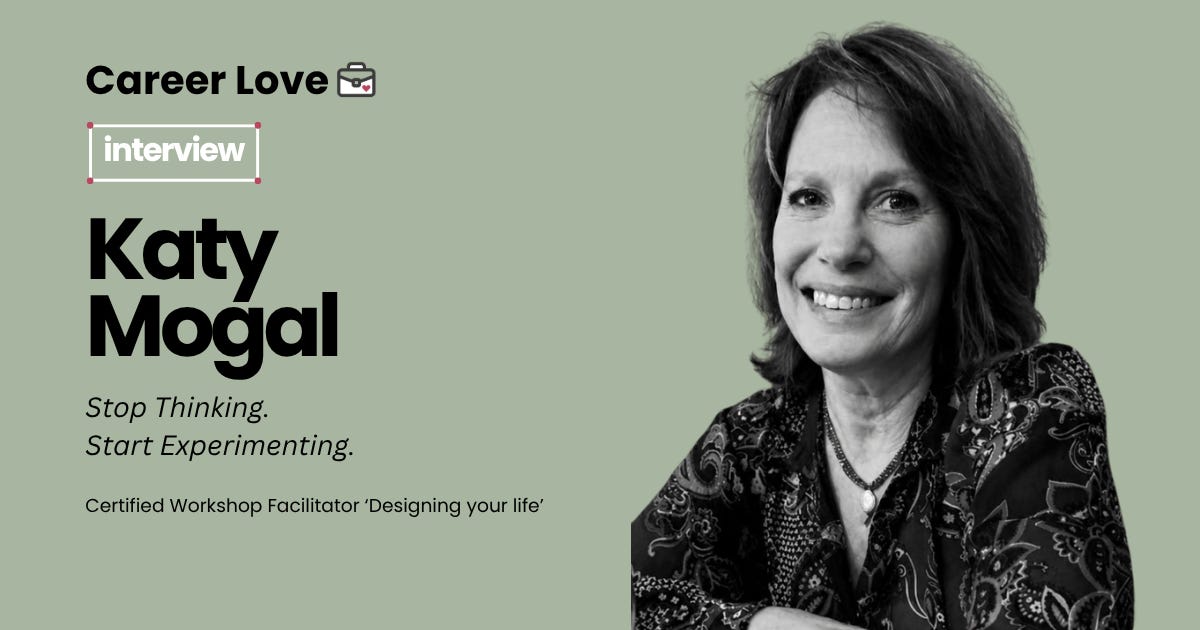
This edition is a personal one for me.
In March 2026, I attended Katy Mogal’s Designing Your Life retreat for women in Rome. It was one of those experiences that gets you out of the day-to-day long enough to ask what you actually want next.
I had read Bill Burnett and Dave Evan`s Designing Your Life book based on the most popular undergraduate class at Stanford University and knew that this design thinking framework was the missing link in career coaching.
It addresses the gap I see most often in my coaching work: people who know what they want, commit to action but can’t seem to implement the next steps.
That is why I interviewed Katy to dig more into where women can get stuck with career design and how to get unstuck.
Katy spent more than 20 years in high-tech, including a long stint at Google, before leaving in 2023 and building something entirely her own: immersive life design retreats in Rome for mid-career women.
What sets her work apart is the research behind it: her Midlife Audacity Project interviewed women who had made bold moves in midlife to understand what actually makes those changes possible. The retreats are built on the Design Your Life method and her research findings.
I spoke with her about design thinking, dysfunctional narratives, the art of the small experiment and why overthinking is often just procrastination in disguise.
Katy, you had a long career in high-tech, including Google. How did you end up running life design retreats in Rome?
I’ve always had a history of pivots and change was something I pursued rather than avoided. After my MBA I went into market research, then design research in Silicon Valley around 2005, and eventually a 20-plus-year career in high tech, ending at Google.
I also taught in the Continuing Studies Program at Stanford, which is where Designing Your Life originated, so the framework was always in the ether for me.
When Google did a large-scale layoff in early 2023 (a genuine case study in how not to handle a workforce reduction), I took voluntary redundancy.
I knew two things: I didn’t want a full-time job, and I never wanted to work for a big company again. About six months later, Designing Your Life came to Italy.
I went to the workshop, had a real revelation, trained as a certified facilitator, and partnered with a friend called Barbara Balletta who is an Italian travel designer to create a retreat in Rome.
The city felt right. Rome is a place of reinvention and repurposing. It creates the conditions for genuine possibility thinking.
“Design thinking was the first career design methodology I found that matched how change actually happens — iterative, experimental, and built on curiosity rather than certainty.”
— Katy Mogal
What is it about design thinking that helps people get unstuck?
Two things stand out.
The first is learning to treat your moves as experiments rather than irreversible decisions. Women who make successful pivots tend to be natural prototypers — they think: I might not get this right, but I’ll get useful information. That reframe shifts everything. You stop waiting for certainty before you act.
The second is learning to tune into the stories you’re telling yourself. A lot of women in midlife carry what I call dysfunctional narratives. These are beliefs about what kind of career they’re supposed to have, what boxes they need to check. At Google, the culture was intensely ambitious. Everyone was racing to the next promotion. You tended not to stop and ask: “do I actually want to be a director? Is that work I’d enjoy?” Design thinking creates the space to notice what’s been handed to you versus what you actually want.
My own revelation came in the workshop itself. I’d convinced myself my next chapter was a master’s degree in Italian literature. When I presented it to the group, the feedback was immediate: you’re not excited about this at all.
You sound like you think you have to do it. They were right. Language study is solitary and fixed. This is the opposite of what energises me. That single piece of feedback changed my direction entirely.
Where do people go wrong when they try to use design thinking to pivot?
The most common mistake is not scoping the experiment small enough. A good prototype is the smallest action that generates real information. Not a thought experiment. Not a five-year plan. A conversation.
I coached someone recently who had spent months in her head thinking about moving into executive coaching. She finally ran a small experiment: pro bono coaching sessions with people in her network.
Afterwards, the question she asked herself wasn’t ‘was I good at it?’, but ‘how did it feel?’ That’s the question that matters.
There’s a story from the Designing Your Life book that I love: a woman in Silicon Valley dreamed of opening an Italian deli. She planned everything: the vendors, the merchandising, the spreadsheets. It was a success.
However, she sold it after six months, because she hadn’t asked herself one question: how is working in retail standing in a store interacting with customers every day actually going to feel? We’re trained to be analytical. We’re not trained to ask what something will feel like from the inside, every day.
“You can be so caught in the wave of performance and promotion that you never stop to ask: what do I actually like doing every day?”
— Katy Mogal
What about women with real constraints — financial pressure, family responsibilities, a career break?
A career pivot doesn’t have to be a dramatic leap. For many women, it has to be a career change that ensures that they keep their income while moving toward something more aligned.
The key is learning to describe your skills at their essence rather than through your job title.
This means reframing what you do: e.g. “I’m not a high-tech UX design leader — I’m someone who unearths insights and helps teams turn them into action. That applies at Google and in a completely different sector.”
The context shifts; the capability remains. Career returners especially tend to undersell themselves here. The red thread is still there after a break. Don’t let the gap convince you it isn’t.
Tell me about your research project.
I’m running the Midlife Audacity Project with a former Google colleague who has an anthropological background. We’re interviewing women who’ve made bold moves in midlife — started businesses, changed countries, left fast-track careers. We have interviewed about 11 women so far.
What sparked it was a pattern from the retreats. One woman would describe something remarkable she’d done — spending half her year in Italy. And then another woman would say, ‘I wish I could do that’, but somehow feel she couldn’t. I kept asking: what’s actually different between those two women?
Our current hypothesis is that the ability to make “bold leaps” is learnable. Our goal from the research is to identify the things that women who feel stuck need to learn, so that they can make their own bold leaps.
What’s the single biggest mistake you see pivoters make?
Overthinking as a way of procrastinating. Research, courses and elaborate planning can all feel productive. However, it is often a very sophisticated way of avoiding the actual risk of trying something and finding out it doesn’t work.
Trying to engineer an entire transition before taking any steps will stall you. Change is iterative, not linear.
The other trap is designing for other people’s approval. This means filtering everything through what sounds impressive, or responsible, or explainable. Design thinking asks you to start from what feels energising.
For high-achieving women who’ve spent decades in corporate environments, that is a genuinely difficult shift. But it’s the right one.
“Overthinking is often just a very productive-feeling way of avoiding the actual risk of trying something. Ask yourself: what am I really accomplishing?”
— Katy Mogal
Any last thoughts?
Reframe what a networking conversation actually is. Prototype conversations in Designing Your Life aren’t about presenting your best professional self or looking for a job. You’re trying to understand what a path actually feels like from the inside.
What do people love about their work? What surprised them? What do they wish they’d known?
This approach makes a conversation more genuine, more interesting, and importantly, less transactional. As a result, people are more generous and willing to give their time.
One woman I interviewed for the Midlife Audacity Project had 60 conversations when she decided to make a move. She got three job offers.
All three came from those conversations. Not one from a job board.
Don’t underestimate the power of talking to people and don’t try to do any of this alone.
⚡ This week’s tiny experiment
Pick one path, role, or industry you’ve been curious about. Have one conversation about it this week.
This is not to network, not to look for a job, but to understand what that path actually feels like from the inside.
A potential outreach LinkedIn direct message or email could look like:
Dear XYZ
I noticed that you are (working as role XYZ or have XYZ experience), I am exploring a potential pivot into this area.
Would you have 15 minutes please over the next few weeks for a short Zoom call to ask:
What do you love most about what you do?
What surprised you about this path?
What do you wish you’d known before you started?
Thanks in advance.
Best
Your name
Afterwards, notice how the conversation made you feel. That’s your data.
One conversation. That’s your first design thinking tiny experiment.
Katy Mogal is a certified Designing Your Life facilitator and founder of Designing Your Life Italy, running immersive career design retreats in Rome for mid-career women.
She is also leading the Midlife Audacity Project, a qualitative research initiative documenting bold moves in midlife.
If this article resonated, please share it with someone who needs to stop thinking and start experimenting.
Best,
— Melissa
Certified Career Coach · Gallup Strengths Coach · ICF Member · Zurich, Switzerland
Thank you so much for sharing this, Melissa! What a truly inspiring piece: the way you connect design thinking with the real emotional blocks women face in career transitions is so insightful. Katy’s journey from Google to building something in Rome is remarkable, and the idea of the Midlife Audacity Project gives such a powerful research foundation to what could otherwise feel like ‘just’ personal development. The line about overthinking being procrastination in disguise really hit home. Can’t wait to the next retreat! 🙏✨”