


June 16, 2026
👋 Welcome to Career Love, a free weekly publication for professional mid-career women who want to be seen and valued for the contribution they make at work.
Career Love · Issue 06 · By Melissa Birchler
This issue uncovers why the most capable woman in the room is so often the one who gets overlooked, and the single shift that makes your value impossible to miss.
Think about the most capable person you work with. Now ask whether the people deciding her future could say, in one sentence, what problem she is known for solving. Often they cannot name it, and that gap is the whole problem.
I’ve watched this play out in my corporate roles in Australia, Switzerland and Germany. Take two candidates with comparable records. One can say plainly what problem she solves.
The other fumbles to find the words or waffles on with a long-winded explanation. When the next senior role opens, it’s the first candidate who comes to mind, and not because she’s better at the work.
We assume the right people can already see it
We tend to think there are two explanations. The first is confidence, and confidence does play its part. Many capable women hold back from naming their own value out loud.
But the second is less obvious, and I think more important: the assumption that the right people can already see the value you bring to an organization.
The belief that if you simply keep doing excellent work, the people who matter will notice it, understand it immediately, and act on it.
It’s a nice assumption. The trouble is, it rarely plays out that way. The people who decide who gets promoted are usually super busy, and they tend to see only a fraction of what you actually do.
They are not studying your contribution. They are forming a quick impression from whatever is visible and easy to recall. If your value has never been put into clear words, there is nothing for them to hold on to, and an impression about you just emerges organically. Whether it is accurate or not is the question.
This isn’t a competence problem. It’s a visibility and communication problem, and it’s a different thing entirely.
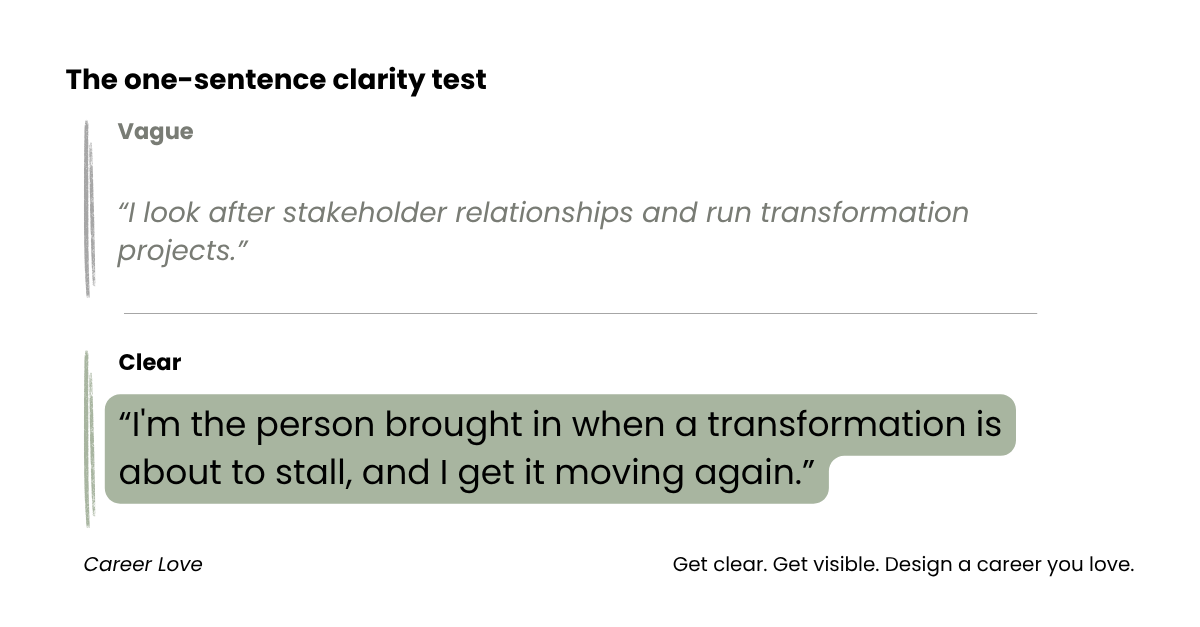
The one-sentence test
Here’s how it shows up in my career coaching work. A client will tell me, with absolute certainty, “I know I’m good at what I do.” I believe her. Her past performance says so.
But when I ask her to explain, in one sentence, what problem she solves, in 9 out of 10 cases, she struggles.
Here's a before and after example highlighting the power of clarity.
Vague: "I'm responsible for client relationships and account growth."
Clear: "I'm the person clients ask for by name, and the reason they don't leave."
The value provided in the second sentence is real. It has simply never been put into words. And what has never been put into words cannot be repeated by a sponsor in a meeting she isn’t in. It can’t travel. It stays a private fact in a place where only public facts get promoted.
The meeting you are not in
Imagine a meeting where your name comes up and you are not in the room. Your sponsor has thirty seconds to say why you are ready. If you have never communicated to them that sentence, they have to invent one on the spot. Most people don’t.
The myth that good work speaks for itself
I believe that we have mistrained a generation of capable women to believe that their work should speak for itself. It’s a great idea in theory. But, unfortunately it is wrong.
Work doesn’t speak. People speak, on the strength of what they can see, remember, and pass on.
If the decision-makers around you can’t describe your value in a sentence, you are leaving them to make one up.
This is where confidence and visibility come together.
Why this feels like bragging
Many women hear “make your value visible” and recoil, because it sounds like self-promotion, like bragging, like becoming the loud and brash colleague they avoid at all costs. So they choose silence and call it integrity and professionalism.
But visibility done well is not bragging. It’s making sure the people who decide have accurate information.
There’s nothing self-serving about being accurately understood. The bragger inflates. The clear professional simply makes sure the record is straight.
That distinction matters, because it is the permission slip that lets capable women step forward without betraying their values. And often, the confidence follows the clarity rather than the other way around.
The three things that actually move a career
This is the problem I am building my career coaching work around. Not polishing CVs. Artificial intelligence has commoditised the CV, and it was never the bottleneck anyway.
The bottleneck with career management for women is upstream: clarity about your distinctive value, the language to express it, and the confidence to let it be seen by the right people.
Get those three right and the rest tends to follow: the promotion, the seat at the leadership table, the more interesting work. Get them wrong, and the most capable woman in the room stays the best-kept secret.
The cost is not only personal
And the cost of leaving this unsolved isn’t only personal. Every organization that loses or overlooks a senior woman it spent years developing is paying for a problem it has misdiagnosed. It assumes its best people are being seen clearly when, in fact, they are not.
The good news is that clarity is a skill. And skills can be taught.
Best,
Melissa
Licensed Career Coach · Gallup Certified Strengths Coach · ICF Member · MAS Career Counselling ZHAW (in progress) · Zurich, Switzerland
Career Love is a free weekly publication for professional mid-career women who want to be seen and valued for the contribution they make at work. Subscribe to get every letter delivered to your inbox.